
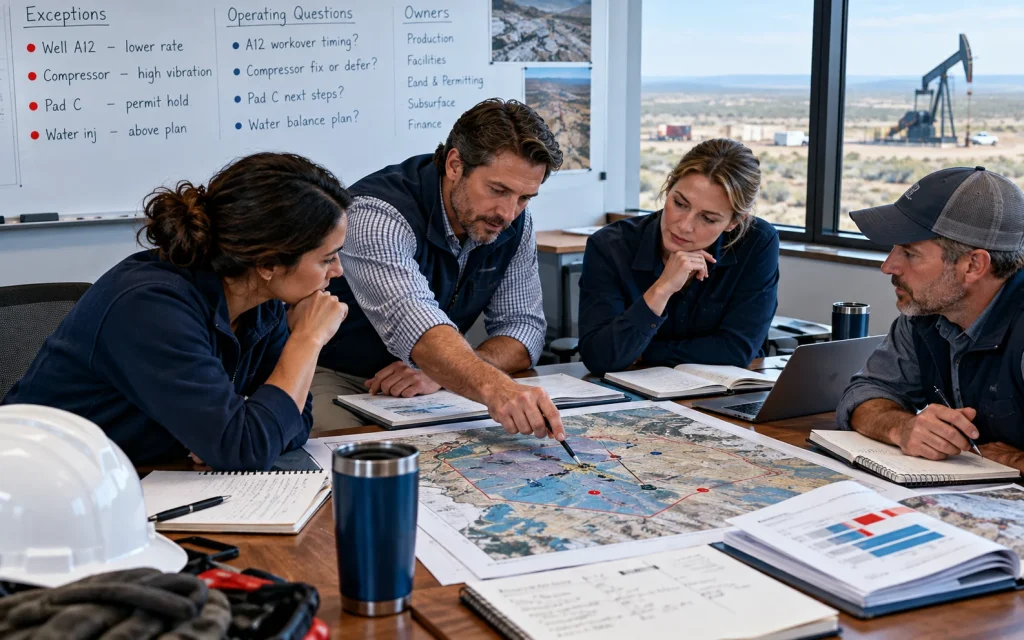
A COO needs a prioritized list of operating questions, the evidence behind each one, and a clear owner for the follow up. A field meeting should connect reported changes with the people who know the work.
The goal is not to make the field team explain every financial line. It is to focus their knowledge on the changes that matter and distinguish an operating issue from a reporting issue early.
Select exceptions the team can influence
Start with material production movements, recurring cost changes or work tracking differently from the plan. Define the review period and property population. Avoid mixing stale data, different ownership bases and newly added wells into one unexplained ranking.
For each exception, write the question in operational terms. Which well’s volume changed? Which service category increased? Which AFE work category is driving the variance?
Put the timelines together
Compare the production period, service activity and financial posting period. A repair performed earlier can appear in the current expense review. Downtime can affect volume before the related invoice arrives.
The shared review should make those timelines visible. That lets finance ask a better question and lets the field team supply the missing context without reconstructing the entire ledger.
Ask for an explanation that can be checked
A fictional property with lower volume and higher maintenance cost might have planned intervention work. The review needs the work date, scope and observed result, not just the phrase we worked on it.
Specify what would confirm the explanation. It might be the supporting service record, a corrected property assignment or a subsequent production period review. The required evidence should fit the question.
Close the loop in the next meeting
Record the owner, expected follow up and next check. Keep unresolved reporting questions separate from operating actions so the team does not perform field work to solve a mapping problem.
Use a saved review scope to reduce repeated setup. Upstream+ well, LOS and AFE views can frame the conversation around the same assets and periods. Field context turns that reporting into an actionable explanation.
The most valuable meeting output is a short list of questions that now have better evidence and a person responsible for what happens next.
Research and references
These sources offer background for the review question. The worked examples and review methods above are Upstream’s practical guidance.
- Contemporary performance measurement systems: A review of their consequences and a framework for researchManagement Accounting Research · 2012 · Peer-reviewed literature review
Research perspective on performance measurement and its consequences.
- A review of dashboards in performance management: Implications for design and researchYigitbasioglu & Velcu · International Journal of Accounting Information Systems · 2012 · Peer-reviewed literature review
Research perspective on dashboard design and drill-down.
Common questions
Should every variance go to the field team?
Prioritize material questions and first check whether scope, timing or classification explains the change.
What should a field meeting follow up contain?
The specific property or work question, supporting evidence, responsible person and next check date.
Put the question to work
Explore the connected workflow for leadership or bring your well data question to a working session.