

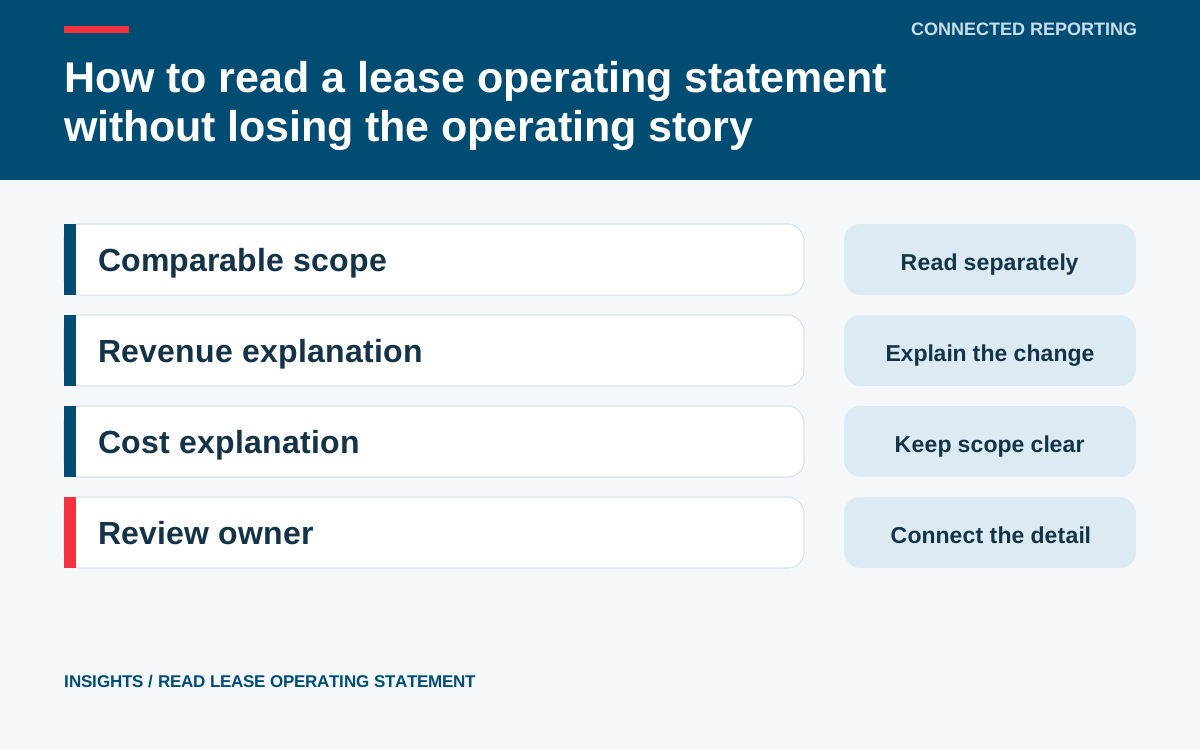
A lease operating statement becomes useful when you can connect its financial movements to the properties, periods and work behind them. Start by confirming the reporting scope. Then review revenue, operating expense and capital separately before interpreting the cash flow lines.
The temptation is to read from the bottom up: did the total improve? That question matters, but a favorable total can conceal an expensive repair, a production decline or a change in the wells included. A good review makes those explanations visible.
Establish what the statement includes
Write down the period, properties, ownership basis and reporting basis before comparing anything. A cash oriented view and an activity period view can tell different stories about the same well. So can a gross view and an ownership adjusted view. Save those definitions with the review rather than relying on the person who prepared it to remember them.
Read the movements separately
Look at revenue first, then recurring operating cost, then exceptional work and capital. For each material movement, ask whether it reflects activity, timing, classification or scope. A revenue decline does not establish a production problem by itself. An expense increase does not establish waste. Both are starting points for investigation.
Keep operating cash flow and total cash flow distinct where your layout separates them. Use your organization’s definitions and sign convention; do not infer the formula from a label alone.
Follow one material question into the detail
Suppose revenue is lower while operating expense is stable. Review the relevant production volumes, realized pricing where available, posting timing and ownership changes. Identify the property or category responsible for the movement. The output should be an explanation tied to supporting records, with unresolved questions named explicitly.
Build a review others can repeat
Carry forward the accepted scope and layout. Record the explanation beside the question, assign the next action and decide when it will be checked again. A reusable review is more valuable than a spreadsheet that only its author can explain.
Upstream+ brings LOS, well and budget views into the same review conversation. Start with the statement; use the connected views to decide which question deserves attention next.
Research and references
These sources offer background for the review question. The worked examples and review methods above are Upstream’s practical guidance.
- Beyond Accuracy: What Data Quality Means to Data ConsumersWang & Strong · Journal of Management Information Systems · 1996 · Peer-reviewed research
Research perspective on evaluating data quality beyond accuracy.
- A review of dashboards in performance management: Implications for design and researchYigitbasioglu & Velcu · International Journal of Accounting Information Systems · 2012 · Peer-reviewed literature review
Research perspective on dashboard design and drill-down.
Common questions
What should I check first in an LOS?
Confirm period, property scope, ownership basis and reporting basis before interpreting a movement.
Does a lower cash flow total explain the cause?
No. Review revenue, operating costs, capital and reporting timing separately to locate the driver.
Put the question to work
Explore the connected workflow for los & loe or bring your well data question to a working session.
A worked LOS review: separate the reasons the result changed
Start with the question an operating team actually has: why did this property generate less operating cash in August? The example below uses invented figures for one property, on the same net ownership basis, for two complete production months. Revenue is presented as a positive inflow and operating expense as a positive outflow. That presentation convention is part of the example, not a rule for every accounting export.
| Measure | July | August | Change |
|---|---|---|---|
| Net oil sold, barrels | 1,000 | 900 | −100 |
| Realized price per barrel | $70 | $65 | −$5 |
| Revenue | $70,000 | $58,500 | −$11,500 |
| Operating expense | $25,000 | $28,000 | +$3,000 |
| Operating contribution before excluded items | $45,000 | $30,500 | −$14,500 |
The change has three components. Holding July price constant, selling 100 fewer barrels reduces revenue by $7,000. Pricing August’s 900 barrels $5 lower reduces revenue by another $4,500. The $3,000 expense increase explains the rest. The bridge reconciles: $45,000 − $7,000 − $4,500 − $3,000 = $30,500. Volume, price and expense need different follow up questions; a single unfavorable total cannot tell the team which action to take.
This simplified example excludes gas, differentials, taxes, capital, corporate overhead and other possible adjustments. Call the residual “operating contribution” rather than company profit or free cash flow. Before using the method on a real LOS, agree which items belong in revenue and expense and what the subtotal is intended to measure.
Read the statement in a sequence you can repeat
1. Confirm property, period and ownership
Write down the property identifier, production period, posting cutoff and interest basis. A gross production chart and a net financial statement can both be correct and still be unsuitable for a direct ratio. If the ownership interest changes between periods, show that change before drawing a performance conclusion. Confirm whether an adjustment posted in August belongs to August activity or corrects an earlier month.
2. Reconcile revenue before interpreting the trend
Look at volumes, realized price and other revenue categories separately. Ask whether sales were recognized for the same production period, whether the measurement source changed, and whether the comparison includes the same products. If revenue is credit signed in the source ledger, parentheses may reflect the bookkeeping convention. Do not infer that a well lost money simply because an exported revenue line is negative.
3. Split recurring expense from exceptional activity
Identify the accounts behind the expense movement. A higher repair bill, a catch up allocation and a recurring disposal rate increase can produce the same total change while implying different next steps. Keep the invoice or allocation supporting each material movement available. Confirm that capital work has not moved into operating expense because of a mapping change.
4. Add the operational context
Bring production, downtime and relevant work activity into the discussion. Use the same property and time window. A lower expense total during a shut in month does not establish better efficiency, and a repair month should not automatically become the next month’s run rate. State what the records support and what remains a hypothesis.
Turn the review into a decision record
A useful review ends with an explanation, an owner and a next step. For the fictional example, the finance owner can confirm the price bridge; the operating owner can investigate the 100 barrel reduction and the work behind the $3,000 expense increase. Neither should be asked to approve a workover solely from this table. The statement supplies evidence for an investigation; the decision also needs the relevant technical scope and expectations.
- Observation: operating contribution fell $14,500 on a comparable basis.
- Supported explanation: $7,000 volume impact, $4,500 price impact and $3,000 higher expense.
- Open question: is the volume reduction temporary, and is the extra expense recurring?
- Next evidence: production history, work records and the invoices or allocations behind the expense.
- Review owner: assign a person and a date for resolving each question.
Research on data quality by Wang and Strong supports considering whether information is appropriate and understandable for the task as well as accurate. The review sequence and invented example here are our practical application, not an oil and gas method tested by that study.
Explore the Upstream+ LOS views, or continue with the LOE comparison guide. In a demo, ask to follow one movement from the selected period and property into the available supporting records.
Watch the review workflow
AI narration · Real application views with fictional demonstration data.
Read the video transcript
How do you review a Lease Operating Statement? Start with the property, the period and the ownership basis. Confirm what is included before comparing figures. Then separate revenue, Lease Operating Expense and capital costs. Follow the account detail behind a variance. A change is a question to investigate, not an automatic explanation. Upstream+ is a SaaS-based tool that works alongside existing software. Its views, analysis and drill-down help you examine well economics using your existing data. Bring the underlying detail into the conversation, then let your team decide the next step.