

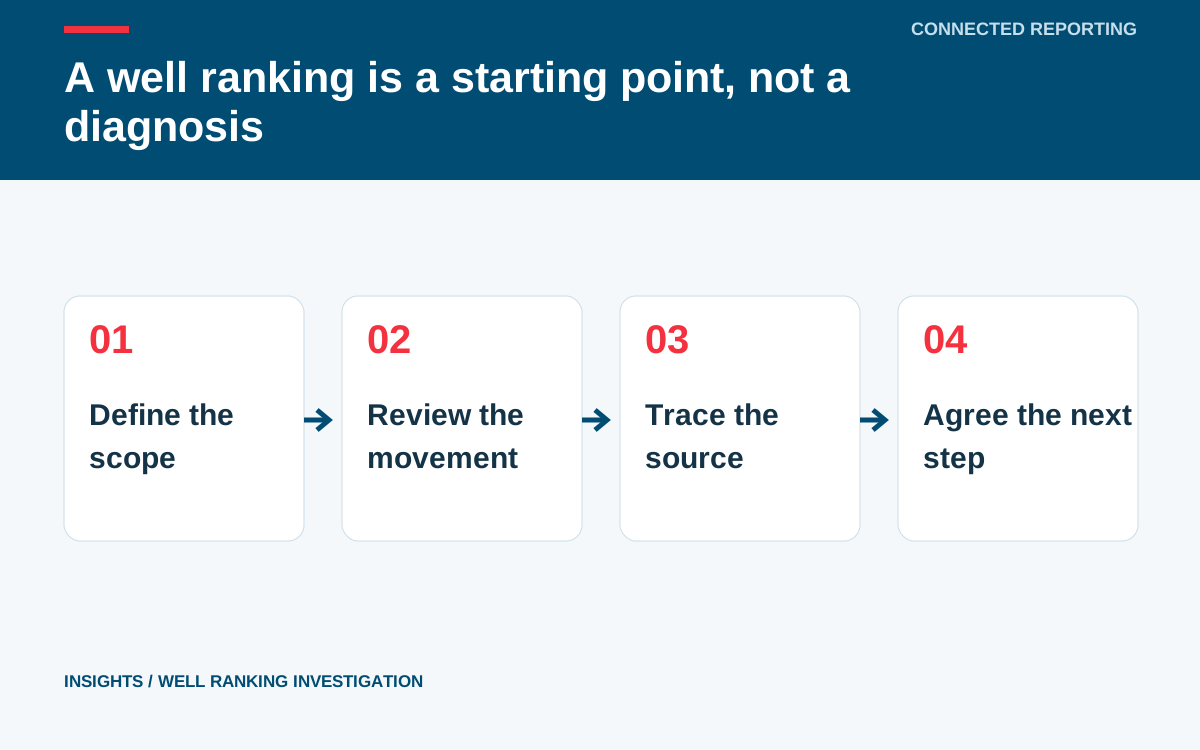
A well ranking helps you choose where to investigate. It does not explain why an asset sits at the top or bottom. The next step is to examine the selected measure, the comparison period and the work behind it.
The lowest cash flow well, the largest cost increase and the fastest production decline may be three different properties. Choosing a ranking without naming the operating question can focus a meeting on the wrong list.
Rank for a decision
If the question is recurring cost, rank the relevant operating expense measure. If it is lost production, review volumes and downtime context. If it is capital execution, use the relevant budget or AFE comparison. Avoid asking one ranking to answer every question.
Document the unit and basis. A gross volume ranking answers a different question from an ownership adjusted financial ranking. The measure should match the decision the audience can make.
Check the comparison population
Separate producing wells from properties with different operating status when that distinction matters. A newly acquired well may have incomplete history. A shut in well may still incur legitimate costs. A property with a late posting may appear unusually expensive in one month.
Those conditions belong in the explanation. They are not reasons to suppress an uncomfortable result.
Investigate one exception completely
Take the highest priority property and follow its timeline. Which category changed? What activity occurred? Was the effect limited to one period? Does production show a corresponding movement? What does the field team know that is absent from the ledger?
In a fictional review, a well appears among the largest expense increases because a planned repair was posted in the current month. The next question is whether that work restored the expected production, not whether every high cost well should receive a spending cut.
Return a usable conclusion
State what the ranking revealed, what the detail established, and what remains unresolved. Assign an owner and a next review date. Preserve the scope so another reviewer can reproduce the result.
Upstream+ well and LOS views support this progression from a list of exceptions to a more specific operating conversation. The ranking earns its place when it leads to an action supported by evidence.
Research and references
These sources offer background for the review question. The worked examples and review methods above are Upstream’s practical guidance.
- A review of dashboards in performance management: Implications for design and researchYigitbasioglu & Velcu · International Journal of Accounting Information Systems · 2012 · Peer-reviewed literature review
Research perspective on dashboard design and drill-down.
- EIA-914 Production Report MethodologyU.S. Energy Information Administration · Authoritative government methodology
Industry context for production definitions and estimation methods.
Common questions
Which well ranking is best?
Use the ranking that matches the decision: production, operating cost, financial movement or budget execution.
Can I infer the cause from rank alone?
No. Review the reporting scope, timeline, supporting activity and field context.
Put the question to work
Explore the connected workflow for well economics or bring your well data question to a working session.