
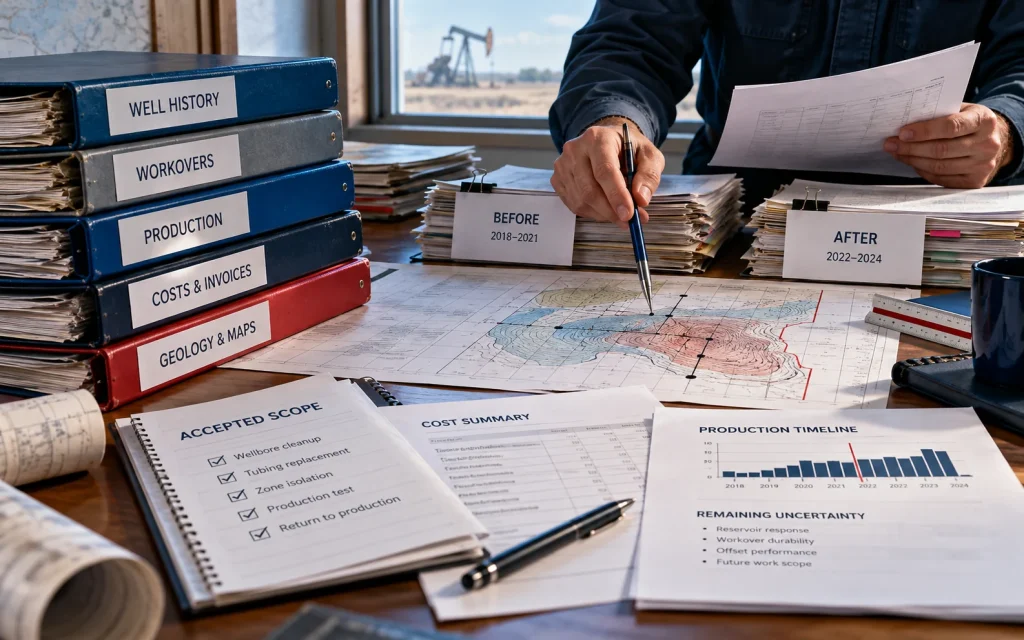
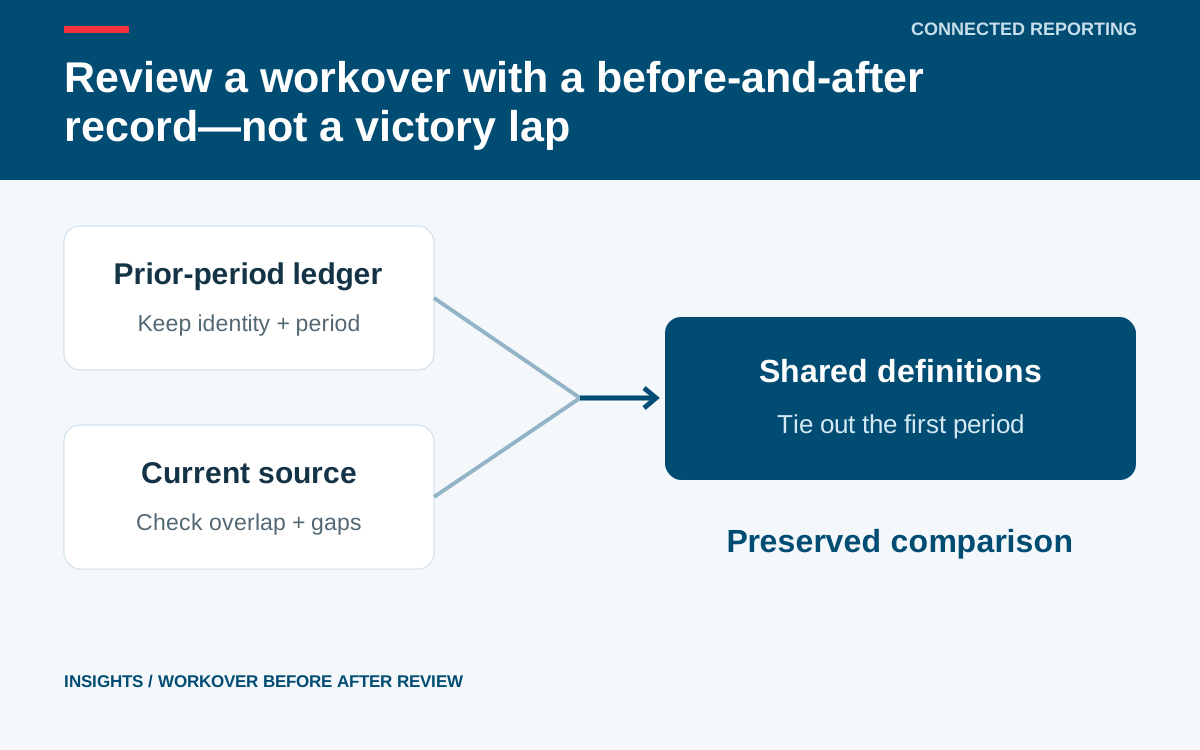
A workover review needs the planned scope, recorded cost, timing and subsequent operating observations. Compare the before-and-after record without assuming that every later movement was caused by the intervention.
The operating team deserves a review that distinguishes what was intended, what was performed and what the available evidence shows. A production rebound is relevant; it is not the entire financial or technical conclusion.
Capture the expectation before the work
Identify the property, intended outcome, planned scope and accepted budget or AFE. State the review horizon and the measures the team will use. The expectation should be recoverable after the work is complete.
If scope changes, preserve the original expectation and the approved revision. Otherwise the final review can quietly move the target to match the outcome.
Align the timelines
Record the activity date, production periods and financial posting periods. Confirm whether the actual cost review includes all known invoices and whether commitments or remaining work sit outside it.
A fictional intervention performed late in June may affect only part of that month’s production. Comparing the full June volume with July without accounting for timing can exaggerate the apparent response.
Compare observations with the stated measure
Review the relevant product volumes, uptime context and costs under the accepted definitions. Use a comparable baseline and acknowledge other conditions that could affect the result.
Do not turn a simple before-and-after chart into an unsupported causal claim. The engineer’s explanation and supporting operating records belong with the financial comparison.
Decide what should happen next
Separate the findings: completed scope, cost against plan, observed production response and unresolved evidence. The next action might be continued observation, additional analysis or a review of why scope expanded.
Upstream+ well, LOS and AFE views support this shared timeline. They can bring the reported production and spend into one conversation, while the team supplies the engineering judgment.
A good workover review is useful even when the outcome is mixed. It tells the organization what it learned and what should change in the next decision.
Research and references
These sources offer background for the review question. The worked examples and review methods above are Upstream’s practical guidance.
- EIA-914 Production Report MethodologyU.S. Energy Information Administration · Authoritative government methodology
Industry context for production definitions and estimation methods.
- Cost Estimating and Assessment GuideU.S. Government Accountability Office · GAO-20-195G · 2020 · Authoritative government guide
Cost-management reference; apply its general principles to your project scope.
Common questions
Does a production rebound prove the workover caused it?
Not by itself. Review timing, baseline, other conditions and the engineering evidence.
When is the cost review complete?
When its stated scope includes the accepted records required for the review. Label outstanding invoices, commitments or work separately.
Put the question to work
Explore the connected workflow for budgets & afe or bring your well data question to a working session.