

An AFE variance becomes useful when you can identify the work and cost categories responsible for it. Start with the approved comparison, confirm the actual cost scope, and investigate the material differences before drawing a conclusion about execution.
An overrun is a signal. It may reflect higher quantities, different rates, additional scope, posting timing or classification. Each explanation implies a different follow up.
Confirm the baseline
Identify the AFE, property, ownership basis and budget version. Make clear whether the comparison uses the original approval or a revised estimate. If scope changed, show that change explicitly rather than comparing a new scope against an old expectation without explanation.
Confirm what the actual column includes. Posted cost, committed cost and forecast remaining cost are different measures. Use them separately unless your reporting definition combines them transparently.
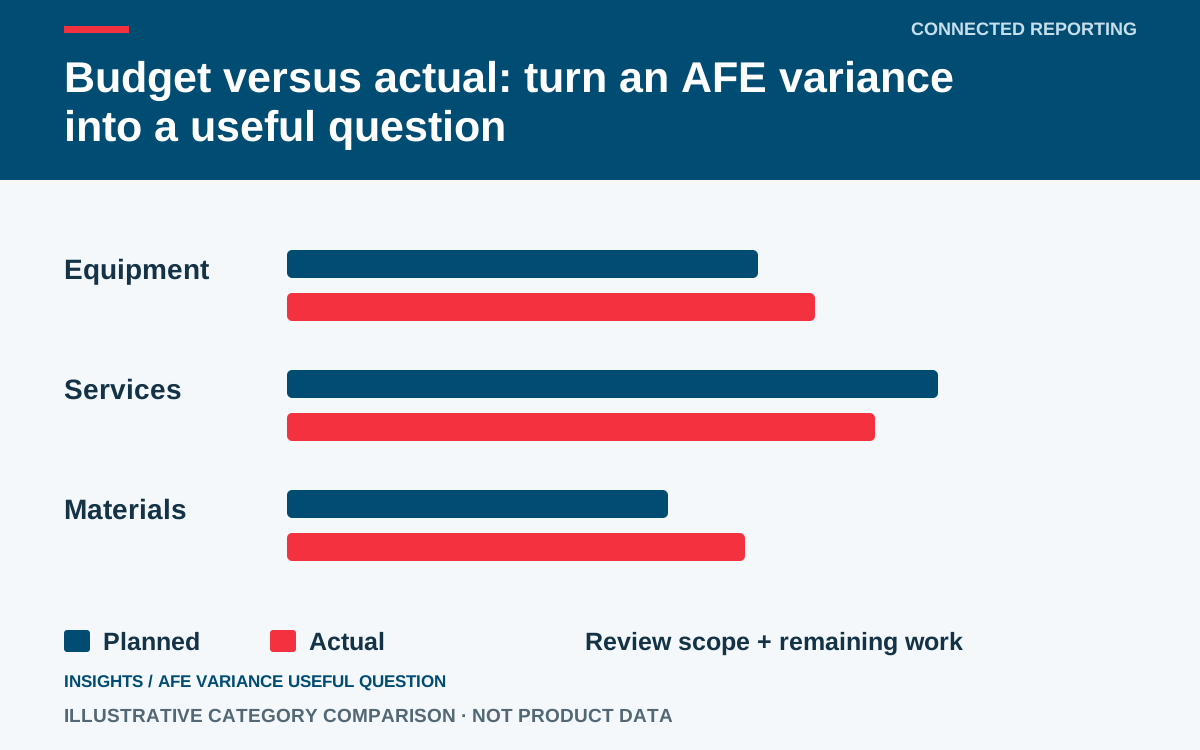
Move from total to category
In the fictional Northline Basin application, AFE NBO 26 004 shows a $215,542.20 budget and $256,495.22 of actual cost. The difference is $40,953.02 over budget, or approximately 19% of the budget.
The detail is more useful than the percentage alone: lease operating expense, workovers, facilities and equipment each contribute to the difference. Those categories tell the reviewer where to ask for the supporting work record.
Test the explanation
For the largest category, compare planned work with completed work. Ask whether quantities changed, whether rates differed, and whether a later phase was charged earlier than expected. Separate an approved change from an unexplained difference.
Do not describe posted cost as final cost while work or invoices remain outstanding. The current variance and the expected completion position belong beside each other, clearly labeled.
Make the review actionable
The output should identify the comparison used, the category driving the movement, the evidence behind the explanation and the next decision. An engineering lead might need a revised completion forecast. Finance might need a coding correction. Operations might need to review a repeated scope change.
The best variance conversation ends with a specific responsibility, not a red number everyone has already seen.
Research and references
These sources offer background for the review question. The worked examples and review methods above are Upstream’s practical guidance.
- Cost Estimating and Assessment GuideU.S. Government Accountability Office · GAO-20-195G · 2020 · Authoritative government guide
Cost-management reference; apply its general principles to your project scope.
- A review of dashboards in performance management: Implications for design and researchYigitbasioglu & Velcu · International Journal of Accounting Information Systems · 2012 · Peer-reviewed literature review
Research perspective on dashboard design and drill-down.
Common questions
How do I calculate an AFE overrun percentage?
For an overrun, divide actual cost minus budget by budget and multiply by 100. Keep the sign convention of the displayed report clear.
Is actual cost the same as final expected cost?
Not necessarily. Posted actuals, commitments and forecast remaining work need distinct definitions.
Put the question to work
Explore the connected workflow for budgets & afe or bring your well data question to a working session.
A worked AFE review: recorded cost is only part of the picture
An authorization for expenditure establishes an agreed cost scope and baseline for a project. A useful review compares that baseline with recorded costs and the expected cost of finishing the same scope. An under budget invoice total does not prove that a project will finish under budget.
Consider this invented AFE with a $100,000 approved budget. Recorded actuals total $80,000. If the review stops there, it appears to have $20,000 of room. The team also identifies $8,000 of incurred work awaiting invoices, $7,000 of open commitments for work not yet performed, and $12,000 of additional work needed to finish. These categories are mutually exclusive in this example.
| Component | Amount | Meaning in this example |
|---|---|---|
| Approved budget | $100,000 | Accepted baseline |
| Recorded actuals | $80,000 | Already recorded |
| Uninvoiced incurred work | $8,000 | Performed, not in actuals |
| Open commitments | $7,000 | Unperformed, already committed |
| Other remaining work | $12,000 | Unperformed, not committed |
| Estimated cost at completion | $107,000 | $80,000 + $8,000 + $7,000 + $12,000 |
| Forecast overrun | $7,000 | Completion estimate less budget |
The $20,000 gap between budget and recorded actuals is not the amount available for discretionary work. On the stated assumptions, the expected completion cost is $7,000 over the baseline. That is a prompt to validate the remaining work and the budget scope, not a reason to automatically reduce a necessary activity.
Do not add these categories blindly. If recorded actuals already include the $8,000 accrual, adding it again overstates the forecast. If the remaining work estimate already includes open commitments, adding the $7,000 again has the same problem. Reconcile the estimate to the actual reporting basis and make the overlap rules visible.
Choose one variance convention and label it
For cost review, this guide uses actual cost minus budget. A positive difference means spending exceeds the budget; a negative difference means recorded spending is below it. An accounting application may use budget minus actual instead. Both conventions can be useful, but an unlabeled minus sign is easy to misread.
The fictional Upstream+ product screenshot elsewhere on the site shows a budget of $215,542.20 and actual cost of $256,495.22. Actual cost is $40,953.02 above budget, approximately 19.0%. The displayed budget minus actual difference is therefore negative. The sign communicates the calculation convention; the operating conclusion is an overrun in recorded spending for that selected scope. It does not establish the expected final project cost without a completion estimate.
Confirm that the budget and actuals use the same project, currency, ownership basis, work categories and cutoff. If one side includes gross costs and the other net costs, fix the comparison before interpreting a variance percentage. If the baseline is zero, show the dollar variance and describe the unbudgeted item rather than manufacturing a percentage.
Explain a variance before choosing an action
Organize the explanation into scope, quantity, rate, timing and coding. These are investigation categories, not conclusions that a dashboard can supply by itself. Start with the accounts or work categories carrying the difference, then bring in the records and people who know what happened.
- Scope: was additional work approved, or does the estimate include a different completion scope?
- Quantity: were more units, days or service hours required than the baseline assumed?
- Rate: did the agreed price or realized unit rate change?
- Timing: is performed work missing from actuals, or did an invoice arrive after the cutoff?
- Coding: is the expense assigned to the correct AFE and category, with reversals handled consistently?
For an invented $15,000 repair category overrun, an invoice review might identify $9,000 of additional service days, $4,000 of a higher rate and $2,000 of a miscoded unrelated item. Resolve the coding error through the accepted accounting process, then explain the remaining $13,000 against the original assumptions. A cosmetic remapping that makes the variance disappear is not a supported explanation.
Keep a baseline history and an owner for the forecast
Keep the original approved budget, approved revisions and the current forecast distinct. Overwriting the baseline removes the ability to understand how expectations changed. A revision should have an effective date, an approving owner and an explanation of the changed scope. The forecast should state what is known about remaining work and what is still estimated.
Ask the operating owner to validate work quantities and completion status and the financial owner to reconcile actuals and accruals. A disagreement between those two views is useful information. Resolve it before presenting a single completion number as settled. At the next review, carry forward the unresolved questions rather than recreating the assumptions from memory.
The GAO Cost Estimating and Assessment Guide describes general practices for defining scope, documenting assumptions and updating estimates using actual costs. This article applies those ideas to an invented AFE review; it is not a GAO endorsed petroleum procedure or a promise of Upstream+ forecast functionality.
Review the available budget and AFE views, watch the AFE walkthrough, or request a working session. Bring the question you need to answer: the largest recorded variance, the approved baseline, or the records needed to understand what remains.
Watch the review workflow
AI narration · Real application views with fictional demonstration data.
Read the video transcript
How does AFE spending compare with the plan? Start with budget versus actual. Confirm that the costs and the budget cover the same scope and period. Then look at the cost categories behind the difference. Ask whether timing, classification or a change in scope needs further review. Upstream+ is a SaaS-based tool that works alongside existing software. Dashboards, views, variances and underlying detail help your team review AFE versus actual. The tool supports decision-making. Your team brings the judgment. Start with your well data and bring a clearer question to the next conversation.